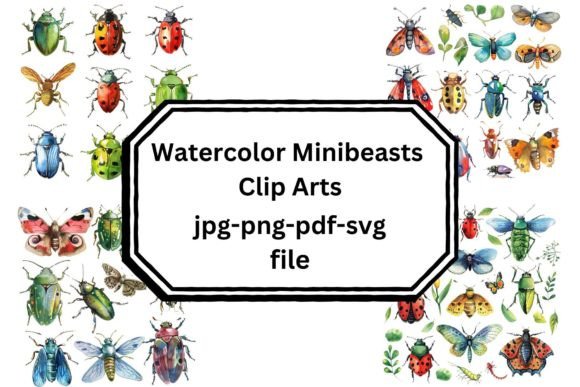
Watercolor Minibeasts Clip Arts: A Designer’s Creative Asset
If you’ve ever needed a quick way to bring a natural, handcrafted feel to your projects, watercolor minibeasts clip arts might be exactly what you’re looking for. These aren’t just cute bug illustrations—they’re versatile design assets that mix the organic texture of watercolor with a loose, playful line. Whether you’re a content creator, a small business owner, or a seasoned designer, there’s a good reason this style has found its way into branding, packaging, and editorial work.
What Makes Watercolor Minibeasts Stand Out
Watercolor minibeasts clip arts capture that delicate balance between messy and refined. Each illustration typically features soft color bleeds, subtle granulation, and uneven edges—qualities that mimic real watercolor paint on paper. The subjects themselves—ladybugs, butterflies, bees, caterpillars, spiders, dragonflies—are rendered with a gentle, whimsical hand that avoids being overly realistic. That’s the whole point. The style feels approachable, warm, and slightly imperfect, which is exactly what makes it work so well in modern design.
From a practical perspective, these clip arts come as transparent PNG files or layered source files, which means you can drop them into almost any layout without wrestling with backgrounds. Combined with the inherent softness of watercolor, they add a tactile, human touch to digital or print work. And because minibeasts are universally recognized symbols of nature, growth, and attention to detail, they carry subtle meaning without shouting.
Where These Watercolor Illustrations Shine
I’ve seen watercolor minibeasts clip arts used in everything from packaging design for organic honey or herbal tea to social media graphics for eco‑friendly brands. Their strength is versatility without sterility. A set of watercolor bees and beetles can turn a plain product label into something that feels crafted, not corporate. In editorial design, they work beautifully as spot illustrations in nature magazines, children’s books, or lifestyle blogs. The subtle transparency lets them sit alongside text without overwhelming it.
For logo design, a single butterfly or bumblebee can become a gentle mark—especially if you pair it with a clean sans serif font or a handwritten script. Because watercolor minibeasts are often isolated elements, you have total control over scaling, rotation, and color matching. That’s why many small business owners turn to these clip arts when building brand identities for farmer’s markets, botanical studios, or educational products. They offer a distinct personality without the cost of a custom illustration.
On the digital side, these assets fit naturally into web design accents, landing page heroes, and email headers. The organic shapes soften otherwise rigid layouts, especially when contrasted with modern typography like a geometric sans serif or a thin serif font. If you’re producing social media graphics for an Instagram account focused on gardening or mindfulness, watercolor minibeasts add a consistent, photo‑friendly visual hook.
How Watercolor Minibeasts Affect Readability and Visual Hierarchy
One thing design newbies often overlook is that decorative clip arts can disrupt readability if used carelessly. But watercolor minibeasts—because of their soft edges and limited detail—tend to sit quietly in compositions. They don’t scream for attention the way a sharp, high‑contrast vector illustration might. That gives you more freedom to layer them behind headlines or nestle them inside text blocks without creating visual noise.
Think about visual hierarchy: a large, detailed butterfly in the corner of a page draws the eye first, then lets the reader settle into the body copy. The watercolor bleeding actually guides the gaze gently around the layout. This is especially useful in packaging design where you need the product name to pop but also want an organic, artisanal aura. By placing a small minibeast near the product name or logo, you create a natural focal point that supports the content rather than fighting it.
In editorial design, I’ve seen watercolor minibeasts used as section dividers or bullet points. A tiny bee next to a subhead makes the hierarchy feel friendly and consistent. Just keep in mind that contrast matters: if your watercolor illustration uses light pastels, pair it with a bold, dark typeface (like a sans serif font with weight) to maintain legibility. The softness of the art can wash out if both text and image are low‑contrast.
Choosing the Right Watercolor Minibeasts Set for Your Project
Not all watercolor minibeasts clip arts are created equal. When evaluating a set, start with the style. Some are painted with loose, wet‑on‑wet techniques that create large blooms of color—great for whimsical posters but tricky for controlled layouts. Others use finer brushwork with sharper outlines, which hold up better in small sizes. Consider where you’ll use them. A set intended for logo design or small badges needs clearer silhouettes, while a set for full‑page wreaths can afford more abstraction.
Next, examine the included styles and variety. Does the set offer multiple angles, sizes, and species? A good collection will have at least ten to twenty unique insects, plus extras like leaves, splatters, or borders. That gives you flexibility for font pairing experiments—for example, placing a delicate butterfly next to a bold handwritten font for contrast. Also check if the files come with layered PSDs or transparent PNGs. The PNGs are convenient for quick use, but layered files let you recolor the watercolor washes to match your brand identity.
Readability considerations might sound odd for clip arts, but they matter. If the watercolor texture is too heavy or the details too messy, the illustration loses its silhouette and becomes a blob. For small spaces (like social media avatars or product thumbnails), look for sets with clear, recognizable shapes. A bee should still look like a bee even when scaled down to 50 pixels.
Pairing Watercolor Minibeasts with Typography
One of the best moves you can make is to treat these clip arts as a counterpart to your display font or body copy. Watercolor is inherently organic, so it pairs beautifully with clean, geometric sans serif fonts (think Montserrat, Open Sans, or Futura). The contrast between precise letters and loose paint creates a modern, fresh look. For a more playful vibe, combine them with a script font that has a hand‑lettered feel—just watch the baseline alignment.
If you’re building a brand identity with watercolor minibeasts, consider using a serif font for headlines to evoke tradition and trust, then rely on the illustrations to soften the overall impression. I’ve seen this work well in packaging design for premium tea or skincare. The serif says “established,” the watercolor says “natural and handmade.” It’s a combination that feels both professional and approachable.
Don’t forget that font pairing isn’t just about style—it’s about weight. A heavy watercolor illustration with thick blooms needs a similarly bold typeface to balance it. A light sketch of a dragonfly, on the other hand, can pair with an ultra‑light modern typography style. Experiment with scale and placement: try dropping a small beetle inside the negative space of a large letter to add intrigue.
Practical Guidance on Licensing and Commercial Use
Before you hit download on any watercolor minibeasts clip art set, check the license. Many premium sets come with a commercial font‑style license that allows use in logo design, branding, packaging, and print projects—even for items sold. However, some limit the number of copies or require attribution. As a small business owner or designer, you want a set that includes a standard commercial license so you can use it without legal headaches.
Also note whether the set is part of a larger bundle of design assets. Some marketplaces offer extended licenses for larger‑scale production, like merchandise or digital products. If you’re planning to sell thousands of units of a product featuring these minibeasts, confirm the license covers that. The last thing you want is to fall in love with a set only to realize you can’t use it in your online shop.
Finally, always test the files on your actual platform. Watercolor textures can sometimes look muddy when compressed for web use. Save a PNG with transparency at 300 DPI for print, and then create a smaller, optimized version for web design. The beauty of watercolor is in its nuances—so don’t let cheap compression wash it out.
Real‑World Examples and Observations
I worked on a rebrand for a local honey producer last year. The client wanted something “artisanal but not rustic cliché.” We used a set of watercolor minibeasts clip arts that included a bee, a butterfly, and a dragonfly. The bees became the primary logo mark, while the butterfly and dragonfly appeared on the back label and social media headers. We paired them with a clean, slightly condensed sans serif font for the logotype. The result was a brand that felt fresh, light, and obviously handmade—without looking like a children’s craft project.
Another project involved an educational blog about insects for kids. The watercolor style made the content feel friendly and less clinical than typical stock photos. The blog used the minibeasts as breaks between sections, rendered at various scales. The soft, irregular edges of the watercolor actually improved the reading experience by adding visual rhythm. The client noticed a bump in time‑on‑page after switching to these illustrations.
What I’ve learned is that watercolor minibeasts clip arts work best when they’re not forced to be the star of every page. Use them as accents, as mood setters, or as a subtle thread that ties your brand identity together. They are not a replacement for a full illustration, but they are a remarkably flexible tool for any creative professional’s toolkit.