Watercolor Funny Cat Tarot Card Clipart
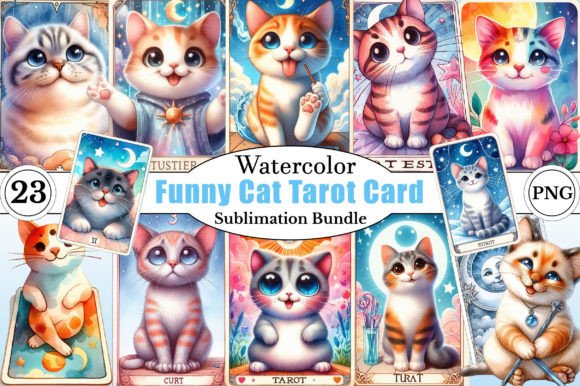
There is a certain magic that happens when whimsy meets watercolor, and Watercolor Funny Cat Tarot Card Clipart delivers exactly that blend of irreverent charm and artistic polish. This collection reimagines traditional tarot symbolism through the lens of feline mischief—think cats lounging on crescent moons, batting at pentacles, or wearing tiny crowns while staring into crystal balls. The watercolor treatment gives each piece a soft, organic texture with subtle color bleeds and granulation that mimics real paint on cold-press paper. The result is a set of design assets that feel handcrafted rather than purely digital, and that human touch makes all the difference in today’s oversaturated market of flat, vector-only graphics.
The palette tends toward muted jewel tones—deep amethysts, dusty rose, sage green, and warm ochre—punctuated by the occasional bright pop of tangerine or cerulean. Each cat carries a distinct expression, from deadpan judgment to wide-eyed curiosity, which gives the collection a narrative quality. You are not just buying isolated illustrations; you are buying characters that can tell a story across a spread, a website, or a product line. The hand-drawn linework underneath the watercolor washes adds structure without sacrificing warmth, making these images feel finished yet approachable. For designers, entrepreneurs, and content creators who want personality without sacrificing polish, this clipart sits in a sweet spot that few other design assets occupy.
The Visual Personality of This Clipart Collection
The first thing you notice about Watercolor Funny Cat Tarot Card Clipart is the contrast between a structured tarot framework and completely chaotic cat energy. Traditional tarot illustrations tend toward the serious, the mystical, the symbolic. Here, you get a cat dressed as a fool, a cat holding a wand like a stolen toy, a cat draped in stars with an expression that clearly says “I meant to do that.” That tension is what makes the collection memorable. It respects the tarot tradition enough to be recognizable, but it subverts it just enough to be shareable and conversation-starting.
The watercolor technique itself deserves attention. Good watercolor clipart avoids the muddy, over-blended look that happens when digital artists simply apply a watercolor filter to vector shapes. In this collection, you can see intentional dry brush edges, uneven pigment concentration, and the kind of happy accidents that only real watercolor mimics can achieve. The paper texture is preserved in the scans, which means when you place these images on a white background, they still breathe like physical art. This matters more than most designers admit—audiences subconsciously register that organic quality as authenticity, and in a world of AI-generated graphics and cookie-cutter templates, authenticity is currency.
The cats themselves are rendered with just enough anatomical accuracy to be recognizable, but with exaggerated features that amplify personality. Big eyes, expressive ears, paws that gesture and point. Some cards feature a single cat in a central composition, others show two or three interacting, which gives you flexibility for layouts, collage work, and layered designs. If you are building a brand identity around whimsy, mysticism, or feline-centric products, this clipart provides a cohesive visual system right out of the box.
Where This Art Style Works Best Across Projects
One of the most common questions I hear from small business owners and marketers is whether a specific design asset can pull double duty across print and digital. Watercolor Funny Cat Tarot Card Clipart handles that crossover with surprising ease.
- Social media graphics and content marketing: The high-contrast, soft-edged illustrations read beautifully on Instagram, Pinterest, and TikTok thumbnails. The watercolor texture adds depth that flat design lacks, helping your posts stop the scroll. Pair a cat tarot card with a whimsical quote or a weekly horoscope-style caption, and you have instantly shareable content that builds brand personality.
- Packaging design and product labels: If you sell candles, teas, journals, or apothecary products, these clipart elements can wrap around packaging with a handmade feel that customers associate with small-batch quality. The muted color palette works well on kraft paper, cream cardstock, and matte finishes without looking garish.
- Editorial design and blogging: Bloggers covering spirituality, self-care, pet lifestyle, or creative entrepreneurship can use these illustrations as section dividers, full-page headers, or featured images. The tarot theme lends itself naturally to articles about intuition, decision-making, and personal growth—topics that resonate with the 20–50 age bracket you are targeting.
- Logo design and brand identity: A single cat character from the collection can serve as a mascot logo for a cat cafe, a pet boutique, or a mystical-themed business. Because the watercolor style is distinctive but not overly detailed, it scales reasonably well from business cards to website headers.
- Print-on-demand merchandise: T-shirts, mugs, tote bags, and phone cases featuring these designs sell well because they combine two viral categories: cats and tarot. The watercolor treatment elevates them above typical meme graphics, making them giftable and visually sophisticated.
For publishers and content creators producing themed planners, oracle decks, or guided journals, this clipart can form the visual backbone of an entire product line. The consistency across the collection means you do not have to mix and match from disparate sources, which saves hours of curation and color correction.
How Clipart Influences Brand Perception and Audience Engagement
Design assets are never neutral. Every visual choice you make communicates something to your audience before they read a single word of your copy. Watercolor Funny Cat Tarot Card Clipart communicates approachability, creativity, and a dose of irreverent humor. It says: we take our craft seriously, but we do not take ourselves too seriously. That tone is incredibly effective for brands targeting adults who value self-expression, playfulness, and authenticity over corporate polish.
The watercolor medium specifically influences readability and visual hierarchy in ways that vector graphics cannot. Soft edges draw the eye in a more exploratory pattern, encouraging viewers to linger on details rather than scanning quickly. This is ideal for editorial layouts, product pages, and packaging where you want customers to slow down and connect emotionally. The clipart's transparent backgrounds and varied sizes also give you control over layering—you can place a cat tarot card behind text for a tattoo-style effect, or use it as a standalone focal point with minimal copy around it.
Consistency is another factor. When you use illustrations from a single collection across your website, social media, and printed materials, you build visual recognition rapidly. Audiences begin to associate that specific cat's expression, that particular wash of indigo, with your brand. Over time, that recognition translates into trust and loyalty. For entrepreneurs launching a new product line, this accelerated brand building is a practical advantage, not just an aesthetic preference.
Engagement metrics also tend to improve with distinctive, human-made imagery. Posts featuring original-looking clipart consistently outperform stock photography and generic templates in click-through rates, shares, and comments. The funny cat tarot theme naturally invites interaction—people want to tag friends, ask which card they would be, or share their own cat stories. That kind of organic engagement cannot be bought with ad spend; it has to be designed into the content itself.
Choosing the Right Set and Evaluating Project Fit
Not all clipart collections labeled “watercolor cat tarot” are created equal. When evaluating a specific set like Watercolor Funny Cat Tarot Card Clipart, look at a few key indicators before you purchase or download.
First, examine the resolution and file formats. For print projects, you need at least 300 DPI with transparent PNG files that include true alpha channels, not just white backgrounds masked out. Check whether the collection provides individual card images as well as composite scenes, and whether the color profile is RGB-friendly for digital use or includes CMYK variants for professional printing. A good collection will specify these details clearly rather than hiding them in fine print.
Second, assess the variety within the set. Does it cover major arcana cards like The Fool, The Magician, The High Priestess, and The World? Does it include enough minor arcana to build a full deck layout if needed? Some collections offer 22 major arcana cards, others offer 40 or 50 pieces including borders, backs, and decorative elements. For branding and marketing use, you likely want more than just a handful of illustrations—you want enough visual vocabulary to create variety without repeating the same image across every post.
Third, consider the style consistency. All cards in a good collection should feel like they belong to the same deck. The same cat faces might appear in different costumes, or the same color palette should carry through consistently. If the collection feels like a random assortment of cat illustrations with tarot labels slapped on, that lack of cohesion will show in your final product. Watercolor Funny Cat Tarot Card Clipart collections that are designed as a system from the start will always outperform those assembled from disparate sketches.
Practical Tips for Licensing, Testing, and Font Pairing
Commercial licensing is where many designers and small business owners get tripped up. When you purchase Watercolor Funny Cat Tarot Card Clipart, verify whether the license covers the specific use you need: merchandise resale, digital product creation, print-on-demand integration, or branding for a client. Some licenses restrict the number of units you can produce, others limit the end product type, and still others require attribution in the form of a credit line. Read the licensing agreement before you build a product line around the clipart, not after.
If you are incorporating this clipart into a branded template or digital product, test how the images hold up at different sizes. Watercolor textures that look gorgeous at 100% scale can become muddy when scaled down significantly for business cards or social media avatars. Preview the clipart at the actual dimensions you plan to use, and consider creating a secondary simplified version for very small applications.
Regarding font pairing, the clipart's handcrafted watercolor style pairs best with typefaces that do not compete for attention. A clean sans-serif font like a geometric or humanist style keeps the layout readable and modern without clashing with the organic illustrations. For a more whimsical feel, a handwritten script font with irregular stroke weights can echo the brush-like quality of the watercolor. Avoid pairing with heavy serif fonts or ornate display fonts that have similar levels of detail—you want contrast between the illustration and the typography, not competition. Think of the clipart as the lead singer and the font as the backing band; each needs its own space to shine.
Finally, test your combinations with a quick A-B comparison. Place your text over a plain background and then over a cat tarot card illustration. Adjust opacity, text size, and placement until the hierarchy is clear at a glance. The goal is for the clipart to enhance the message, not obscure it. When you get that balance right, you will have design assets that work across campaigns, products, and platforms without requiring constant rework.
Watercolor Funny Cat Tarot Card Clipart is more than a collection of cute illustrations. It is a strategic tool for building a brand that feels personal, memorable, and human. Whether you are designing a product line, launching a content series, or refreshing your visual identity, these assets give you a head start on the hardest part of any creative project—creating work that people actually want to look at and share.