Watercolor Adorable Capybara Clipart PNG
If you’ve spent any time browsing design assets for children’s content, social media templates, or eco-friendly branding, you’ve likely encountered a trend that feels both fresh and oddly comforting: the Watercolor Adorable Capybara Clipart PNG. These aren’t just cute animal illustrations—they leverage a specific visual language that blends softness, organic texture, and an almost meme-worthy calmness. Capybaras, the world’s largest rodents, have an inherently relaxed, zen-like expression, and when rendered in watercolor, they become a versatile asset for everything from greeting cards to editorial layouts.
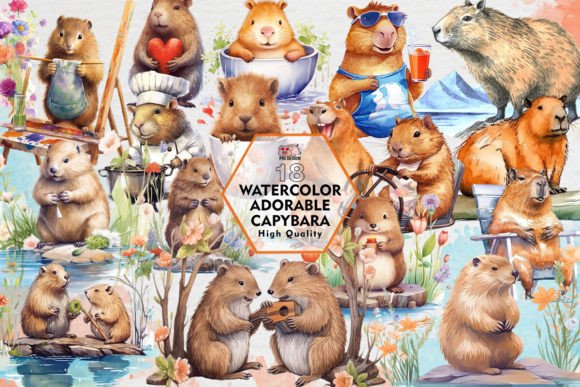
This clipart set typically features hand-painted style capybaras in various poses—lounging, munching, floating, or simply staring blankly with that signature peace. The PNG format means transparent backgrounds, so you can drop them into any project without wrestling with white boxes. The watercolor treatment gives them a gentle, diffused edge, with visible brush strokes, color blending, and subtle grain. That tactile quality is hard to achieve with standard vector flat art, and it’s exactly what makes this asset stand out in a crowded market of digital clipart.
Whether you’re a brand strategist looking for a mascot that says “chill” without being boring, or a crafter building a notebook line, understanding how to use this type of visual element effectively matters. Let’s break down where it shines and how to get the most out of it.
Visual Personality and Why It Works
The Watercolor Adorable Capybara Clipart PNG occupies a sweet spot between illustration and painting. It doesn’t try to be hyper-realistic—the charm lies in the looseness. The watercolor medium introduces organic variations: darker pooling in the eyes, lighter washes on the fur, and occasional paint splatters that add movement. This imperfection feels human and approachable, which is gold for brands trying to escape sterile, corporate aesthetics.
Capybaras themselves carry a unique personality. They’re photogenic, social, and almost absurdly relaxed. In a world of aggressive marketing, a capybara graphic signals patience, friendliness, and a touch of humor. The watercolor style amplifies that softness. Watery pigments and paper-like texture evoke nostalgia, creativity, and emotional warmth. Think of it as the visual equivalent of a deep breath.
For designers, this opens up specific uses where a sans serif font or a clean, modern typography alone might feel too cold. Pairing the clipart with a handwritten font or a rounded sans serif can create a cohesive, playful identity. For example, a blog post about slow living could feature a watercolor capybara drinking tea alongside body text set in a friendly serif font. The contrast—organic illustration next to structured type—adds visual hierarchy and guides the reader’s eye naturally.
Practical Applications Across Projects
This asset isn’t limited to scrapbooking or kid’s room decals. The Watercolor Adorable Capybara Clipart PNG works in commercial contexts when used thoughtfully. Here are some scenarios where it adds real value:
- Social media graphics: Instagram posts, story backgrounds, or Pinterest pins featuring this clipart get higher engagement because the watercolor texture stands out against the flat, polished feeds many brands use. The transparent PNG lets you overlay the capybara on any photo or gradient without awkward edges.
- Packaging design: For products like tea, notebooks, candles, or organic snacks, a soft watercolor capybara on the label communicates natural ingredients and a calm state of mind. It works especially well when paired with a minimalist serif font for the product name and a script font for taglines.
- Editorial and publishing: Children’s books, magazine features about mindfulness, college journals, or wellness guides benefit from illustrations that don’t feel mass-produced. The watercolor look feels artisanal, which supports topics like creativity, nature, or mental health.
- Brand identity assets: If you run a small business around stationery, apparel, or lifestyle coaching, using this clipart as a recurring icon on your website, favicon, or email headers builds recognition. The consistent watercolor style ties everything together, creating brand identity that feels cohesive without being repetitive.
One example: an entrepreneur launching a brand of herbal teas used the capybara clipart across their entire launch campaign. On the website, the capybara sat next to a mugs section. On social media, it appeared in posts about “just breathe.” The visual consistency made the brand memorable, and the hand-painted feel offset the fact that the rest of the site used modern typography. That mix of organic and digital is where the magic happens.
Think About Scale and Placement
Because the clipart has visible brush strokes and paint texture, you want to place it at a size where those details are visible but not overwhelming. On a business card, a small capybara might just look like a blob—instead, reserve it for hero images, banners, or products where the audience can appreciate the craft. For logo design, this particular style works best as a secondary mark or a mascot rather than the main logo lockup, especially if your brand also uses a display font for the wordmark. The watercolor texture doesn’t always hold up at very small sizes due to the loss of grain detail, so test scaling carefully.
Practical Guidance for Choosing and Using This Asset
Before you download a Watercolor Adorable Capybara Clipart PNG set, take a few minutes to evaluate your specific project needs. Not all watercolor cliparts are created equal, and subtle differences can affect your final outcome.
- Assess the color palette. Most capybara sets use earthy browns, greens, and soft yellows. Ensure the tones fit your brand’s color scheme. If you’re working with a cool, modern palette (gray, blue, white), a warm watercolor capybara might clash unless you intentionally use it as an accent. Look for sets that include multiple color variants or that allow easy color adjustment in your design software.
- Check the file quality. A good watercolor PNG should have no white halos around the edges, and the transparency should be clean. Download a sample file and open it in Photoshop, Illustrator, or Affinity to see how the watercolor blending performs against different backgrounds—black, white, and patterned.
- Consider font pairings. The clipart’s soft, organic lines call for complementary typefaces. A handwritten font with a bit of bounce echoes the hand-painted feel. A sans serif font with rounded terminals (like a friendly grotesk) keeps things modern but approachable. Avoid sharp, ultra-condensed serifs or heavy blackletter—they’ll fight with the gentle watercolor shapes. For a recipe card or journal spread, pair it with a script font for the heading and a clean sans serif for body copy.
- Review licensing carefully. Many clipart sets labeled “commercial use” have limitations. The Watercolor Adorable Capybara Clipart PNG might allow you to use it in printed products you sell, but may restrict reselling the raw clipart files or using them in logo trademarks. If you’re a publisher or a content creator selling physical items, read the EULA. Some premium designers offer extended licenses that cover unlimited merchandise—worth the extra cost if your business scales.
- Test hierarchy and readability. When you place the capybara on a page, it becomes a focal point. If you put it next to important text, make sure the illustration doesn’t distract. Lower the opacity slightly or add a subtle screen overlay behind the type. The capybara should support your message, not overwhelm it. For blog posts, use it as a break between sections rather than a background for full-width text.
Commercial Licensing and Real-World Constraints
If you’re a small business owner or an independent publisher, budget matters. The Watercolor Adorable Capybara Clipart PNG you find on marketplaces like Creative Market, Etsy, or Envato Elements may range from $5 to $20 for a set of 10–20 images. That’s a low entry point for a design asset that can lift the entire look of your project. However, avoid the trap of using free clipart from unknown sources—watermarked or low-resolution files waste time and can cause trademark issues if the artist didn’t grant commercial rights. A few dollars upfront saves hours of redesign.
For agencies building brand systems for clients, consider purchasing a multi-use license. You might use the same capybara across a client’s packaging, website, and presentation slides. If the license is per project, buy accordingly. Some designers also offer extended licenses for merchandise—if you’re printing mugs, totes, or clothing, you’ll likely need that tier. Always verify whether the artist requires attribution. Many don’t, but it’s professional courtesy to credit the work when possible, especially in editorial or portfolio contexts.
Another practical tip: because watercolor illustrations have variable opacity and texture, they compress differently in PNG format. If your website loads slowly, consider using a compressed WebP version of the image for web display, while keeping the original PNG for print. For web design, a capybara at 800px wide might be a 300KB PNG—optimize it to under 100KB without losing too much grain by reducing color depth or using a lossy compression tool.
Testing Pairings Before Finalizing
I always recommend creating a quick style tile before committing to a full design. Place your chosen capybara clipart next to a sample heading in a display font (like Playfair Display or a rounded sans serif), a subheading in a handwritten style, and a paragraph in a readable serif or sans serif. Look at the overall mood. Does the capybara feel like it belongs, or does it float apart from the typography? Adjust colors, sizes, and spacing. Sometimes a slight drop shadow or a textured background (like paper or linen) helps bridge the gap between vector text and painted art.
For a blog or social media series, using one consistent capybara pose as your thumbnail element creates instant brand recognition. People scrolling through Instagram will start associating that watercolor capybara with your content. It becomes your visual anchor. Over time, that consistency builds trust—your audience knows what tone to expect before they even read the caption.
At the end of the day, the Watercolor Adorable Capybara Clipart PNG is more than a trendy graphic. When chosen with intention, paired with appropriate typography, and placed with attention to hierarchy, it becomes a professional design asset that adds warmth, personality, and a handmade feel to your work. Whether you’re designing a branding system for a client, producing printables for your Etsy shop, or launching a newsletter, this little capybara can carry a surprising amount of emotional weight. Use it well, and your audience will feel the difference.